Margaret Ross- Managing Classroom Behaviour. 2-day course.

Understanding complex behaviours an using that understanding to improve classroom management.
Professional Development for Implementing UDL in the Classroom- Reflective Thoughts
Participating in a professional development course focused on the application of Universal Design for Learning (UDL) has been an enlightening experience, particularly as I concentrate on designing lessons that cater to the needs of dyslexic students. UDL goes beyond traditional scaffolding and emphasizes the creation of lessons that provide equal access to essential resources, ensuring that every student has the opportunity to succeed.
One of the core principles of UDL that resonated with me is the idea of designing with inclusivity in mind. For dyslexic students, this means incorporating specific design elements that can make a significant difference in their learning experience. These include more white space to reduce visual clutter, using larger and more reader-friendly fonts, and avoiding busy backgrounds or underlining words, which can be distracting or challenging for dyslexic individuals to process.
Furthermore, providing concise and clear instructions within the learning materials is crucial. Dyslexic students often benefit from straightforward, unambiguous directions that help them navigate through the content more easily. Additionally, incorporating options to convert text to speech can be a game-changer for these students, as it provides an alternative means of accessing the material, reducing the reading burden.
Collaborating with the Special Assessment Conditions (SACs) team to determine which resources can best assist diverse learners is a valuable strategy. This collaboration can help identify and implement additional support mechanisms, such as assistive technology or tailored learning materials, to better accommodate the needs of dyslexic students and others with different learning styles.
In reflection, this professional development course has reinforced the importance of UDL as a framework for creating inclusive and accessible learning environments. Focusing on the specific needs of dyslexic students has provided me with a clearer path to designing learning experiences that can make a positive impact. By incorporating principles such as increased white space, reader-friendly fonts, clear instructions, and text-to-speech options, I can create an environment where all students, including those with dyslexia, have an equal opportunity to succeed.
I am eager to apply these newfound insights to my teaching practice and collaborate with the SACs team to ensure that I can provide the best possible resources and support for my diverse group of learners. This approach not only benefits dyslexic students but also promotes inclusivity and accessibility for everyone in my classroom, fostering a more supportive and effective educational experience.
UNDERSTANDING DYSLEXIA IN AOTEAROA
Choose to be around people who improve your life and the lives of those around you.
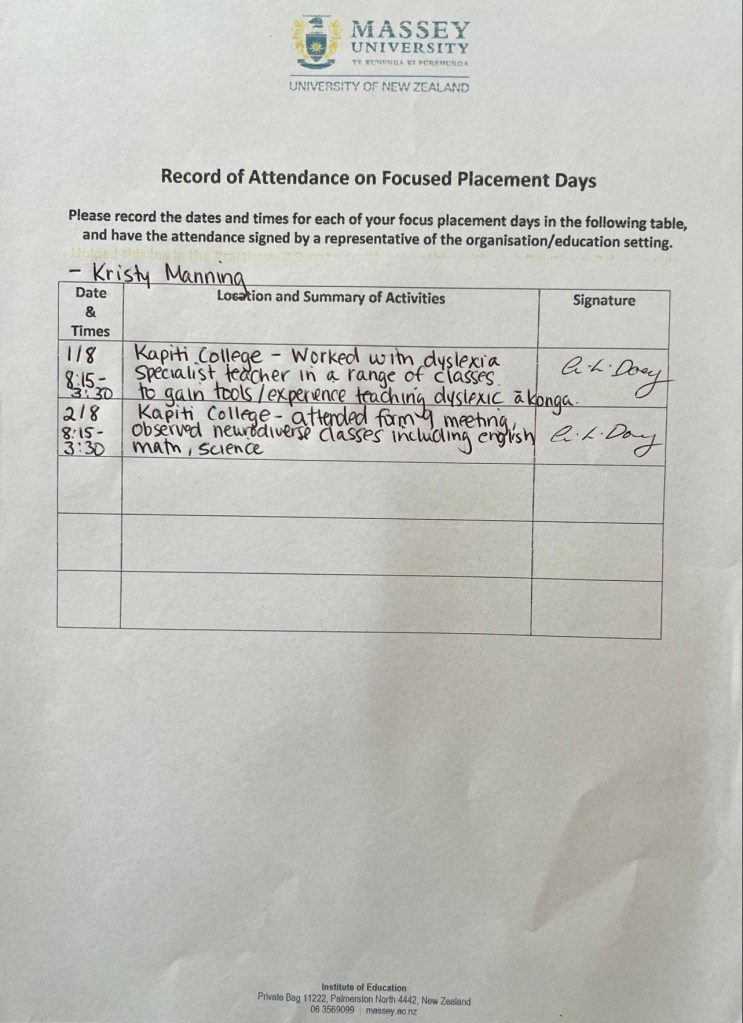
Kapiti College – Dyslexia Team (2 days)
Entering the class I saw a familiar setting, a sea of masked faces glued to cell phones and making small talk with their peers. Yet this year 10 class was a little different- everyone in this class had a diagnosis of dyslexia. At first I tip-toed around that word, not sure what power it had in here. Was it still a bad word? Did it put a heavy label on who they are? It didn’t take long for me to figure out that the answer to both of those questions was NO. These ākonga were unapologetically dyslexic. It was safe to say that there were no shrinking violets amongst them. They were engaged with each other and eager to share with me what they struggled with and what their talents are. More than once debates spontaneous erupted during think, pair, share activities that addressed issues such as the efficiency of masks and the state of our natural environment. When given options of expressing their ideas, most chose to draw their thoughts and discuss ideas with each other. In math, they teamed up to help each other and let the teacher know when they needed to “tap out” for a breather. I was impressed with their self confidence and self management skills.
Although I know it is no longer common to group ākonga by learning preferences, but in this case it seemed to work. The stigma was lifted and conversations were flowing about what they needed to achieve their goals. I would have loved to spent more time with them and the Neurodiversity team. Two days was way too short…

St John Mental Health First Aid (1 day)
Unfortunately, due to COVID my in-class workshop turned into an online class. I say unfortunately because I would have really like to have spoken to and interacted with people directly with this topic. What did I learn? The big takeaway I got was how important it is to just be there for others. Often times, literally, just being with them is all we can do. Ask them how they are, ask them directly if they are thinking about or planning to kill themselves. There are professionals that can help in serious situations, and we aren’t necessarily equipped to do any other advise than to point them to those resources… and then be there for them.

Red Cross First Aid Course (2 days)
It had been years since I attended a first aid course, so I shouldn’t have been surprised that a lot has changed. Due to COVID, we didn’t have any actual ‘hands-on’ practice, besides the use of mannequins, and less emphasis was group work. I found this to be disappointing, as I fondly remember being taught how to immobilize a limb and lift patients – when needing to stabilize a patient. However, it was great to be reminded how important it is to be able to effectively render first aid when needed. It was great to meet a few new people and think about where accidents might happen in the workplace and community.


 Welcome to my PCT page