Term 1
Reflecting on my experiences as a first-year secondary school student teacher during Term 1 has been a journey of growth and adaptation. In this summary, I will touch upon key aspects such as Universal Design for Learning (UDL), behavioural management, classroom management, and ways to improve based on my observations and adjustments.
Universal Design for Learning (UDL):
In my first term, I recognized the importance of fostering an inclusive learning environment through UDL. Initially, I used food rewards to motivate my year 9 students. However, I noticed that this method had unintended consequences, as it created division among the students and discouraged some from participating. This experience highlighted the significance of tailoring teaching methods to accommodate diverse learning styles and abilities. To address this issue, I adapted my approach by shifting from exclusive rewards to inclusive ones. I now use food rewards as exit tickets, which everyone can obtain by answering a question correctly. This change aligns more with the principles of UDL, ensuring that all students have equal opportunities to succeed.
Behavioural Management:
Managing classroom behaviour was another vital aspect of my journey. While my students initially appeared shy, they gradually became more confident as a group. It was essential to establish a positive and respectful classroom culture to support their growth. The shift from using food rewards to scented stickers for marking achievements during class played a significant role in behavioural management. This adjustment not only recognized and reinforced students’ efforts but also fostered a more positive and inclusive atmosphere. The use of stickers allowed me to acknowledge and celebrate small wins, which contributed to a more positive behaviour management approach.
Classroom Management:
Effective classroom management was crucial in maintaining a productive and engaging learning environment. My initial approach of using food rewards had created disruptions and inequality. The switch to scented stickers as a more inclusive method not only improved behaviour but also simplified classroom management. It encouraged students to focus on their work and strive for accomplishments that would be acknowledged with stickers, reducing distractions and conflicts.
Ways to Improve:
As I move forward in my journey as a student teacher, there are several areas where I can further improve:
1. Continuous Assessment: I should consider implementing ongoing assessments to gauge students’ progress and tailor my teaching accordingly. This can help identify students who may need additional support and adjust my methods as needed.
2. Diverse Reward Systems: While the transition to scented stickers was a step in the right direction, I should continue to explore various reward systems and adapt them to the specific needs and preferences of my students.
3. Communication: Maintaining open and clear communication with students is crucial for effective classroom management. Regularly seeking feedback from students and discussing classroom expectations can further enhance the learning environment.
4. Professional Development: I should actively seek opportunities for professional development and mentorship to refine my teaching skills and strategies, especially in UDL and behaviour management.
In conclusion, my first term as a secondary school student teacher was marked by valuable insights into the importance of UDL, behaviour management, and classroom management. Adapting my reward system from food to scented stickers helped create a more inclusive and engaging learning environment. As I continue this journey, I aim to build on these experiences, seeking ways to enhance my teaching methods and ensure the best possible learning outcomes for my students.
Reflecting on my experiences with the senior classes, particularly my year 11 and year 12 students, this term presented a significant set of challenges and unique dynamics that required careful management and adaptation.
Year 11 Class:
In my year 11 class, I encountered a group of aggressive students who consistently challenged classroom rules, particularly in the science laboratory. This situation created safety concerns and disrupted the learning environment, affecting my ability to teach effectively. Moreover, the isolation and bullying of another student compounded the negative class dynamics. Despite my efforts to step in and work with the bullied student, the challenges persisted. I implemented a strategy of removing disruptive and abusive students from the classroom to address immediate issues and maintain a safe environment.
However, I faced difficulties with the senior leadership’s response, as they did not support this action fully. The students often didn’t go to the designated area, and instead, they wandered around the school. In some cases, the dean was not available to escort them to another location. This left me in a challenging position, unable to control the students’ behaviour effectively. These challenges have made it a difficult first term for the year 11 class.
Year 12 Class:
My year 12 class, when present, performed well. However, disruptions arose from students frequently being absent due to sports or cultural activities. These absences made it challenging to maintain a consistent curriculum pace and cover the required material.
Reflections:
1. Behavioural Challenges: The situation in the year 11 class underscores the importance of proactive strategies for addressing aggressive behaviour and bullying. Collaborating with senior leadership and school counsellors to develop a comprehensive approach to behavioural issues is essential.
2. Class Dynamics: It is crucial to foster a positive and inclusive classroom atmosphere to reduce conflicts and promote cooperative learning. Promoting respect and empathy among students can help improve class dynamics and reduce instances of bullying.
3. Administrative Support: It is essential to have clear guidelines and support from senior leadership for managing classroom disruptions. Regular communication with administrators and deans to address issues promptly and effectively is crucial.
4. Curriculum Flexibility: Given the challenges with the year 12 class, it may be necessary to explore flexible teaching methods, such as online resources or supplementary materials, to ensure that the curriculum is covered even when students are absent.
5. Professional Development: Seeking additional training or professional development in classroom management and student discipline can provide teachers with more effective strategies for handling challenging situations.
In conclusion, my experience with senior classes during the first term has been marked by significant challenges, particularly in the year 11 class, which experienced behavioural issues and a negative class dynamic. While the year 12 class was more cooperative, frequent absences posed curriculum challenges. Moving forward, addressing behavioural issues, improving class dynamics, seeking administrative support, and adapting teaching methods to accommodate student absences will be key focus areas to enhance the overall learning experience for these senior students.
Term 2
Reflecting on my experiences in Term 2 with both senior and year 9 classes, it is evident that various challenges in Universal Design for Learning (UDL), behavioural management, and classroom management continued to shape my teaching journey. Here’s a breakdown of the key issues and potential improvements:
Senior Classes:
– One major issue in the senior classes is the lack of communication when new students are transferred into my classes. This abrupt change disrupts the established class dynamics and tests my ability to maintain a structured environment. The students need time to adjust to my rules and expectations, which can be frustrating for both the newcomers and existing students.
Behavioural Management and Classroom Management:
– The year 9 classes returned from the break with new peer groups and heightened disruptiveness. In an attempt to restore structure, seating plans were introduced. However, this strategy was only effective to the extent that students remained in their seats. This posed a significant challenge in a subject like science that requires hands-on lab bench work. The escalating bad behaviours began to pose safety concerns, necessitating a careful evaluation of the necessity of each practical activity.
Ways to Improve:
1. Proactive Communication: To address the issue of new students entering senior classes, it is crucial to establish a clear communication system with school administrators or relevant authorities. This can help ensure that students are informed about teacher changes and reasons for such transitions. Additionally, creating a welcome and orientation process for new students can help them acclimate to the classroom environment more smoothly.
2. Clear Expectations: Establish and communicate class rules and expectations consistently, both at the beginning of the school year and when new students join the class. Encourage open discussions with students about the rules and expectations to promote buy-in and a sense of ownership.
3. Seating Flexibility: In the year 9 classes, consider flexible seating arrangements that accommodate the need for both lab bench work and maintaining classroom management. Incorporate group workstations with clearly defined expectations to allow for collaborative learning without sacrificing safety.
4. Teacher Aide Support: Leveraging the teacher aide appointed for the year 9 classes is a positive development. Collaborate closely with the aide to monitor and manage student behaviour effectively. Develop strategies for interventions when disruptions occur and encourage open communication with the aide to address concerns promptly.
5. Balanced Lessons: Recognize the importance of striking a balance in lesson planning to cater to students with varying paces. Tailor lessons to allow for differentiation, providing both extension activities for faster learners and additional support for those who need more time.
6. Reconnecting with Students: Continue using the engagement information cards and exit tickets as effective tools to reconnect with your students on an individual level. These strategies provide insights into their interests, needs, and progress while creating opportunities for one-on-one interaction.
In conclusion, Term 2 presented unique challenges in UDL, behavioural management, and classroom management. Addressing issues related to new student transitions and disruptive behaviours is an ongoing process that requires proactive communication, clear expectations, and flexible teaching approaches. Utilizing the support of a teacher aide and maintaining a balanced approach in lesson planning are positive steps forward in managing these challenges. The journey of teaching continues to be a dynamic and evolving process, with each term providing opportunities for growth and improvement.
Term 3
Reflecting on my experiences in Term 3 as a first-year teacher in a secondary school, I have observed various developments and challenges in Universal Design for Learning (UDL), behavioural management, and classroom management. Here is a breakdown of the key aspects and ways to improve:
Senior Classes:
In senior classes, I have noticed a decrease in interruptions and improved student engagement. This is a positive development, indicating that the students are settling into the learning environment.
Behavioural Management:
– I have taken proactive steps to reach out to the Special Assessment Conditions (SACs) team to ensure that students receive the support they need. It’s commendable that I am advocating for my students and their success. It can be challenging to watch students decline the extra support when it is available, but my efforts are essential in helping them reach their full potential.
It is noted that distractions such as cell phones and earbuds continue to be a problem, affecting students’ focus and attention. This issue aligns with the broader challenge of managing classroom behaviour and maintaining a conducive learning environment.
Ways to Improve:
1. Support for Students: I will continue to work closely with the SACs team to ensure that students who require extra support receive it. Advocating for their success is crucial, and consistent communication with the team is vital to address the needs of individual students effectively.
2. Differentiation: I will consider implementing differentiated teaching strategies to accommodate students who may be at varying levels of understanding. I will tailor lessons to address diverse learning needs, providing additional support to those who need it and more challenging tasks for those who grasp the material quickly.
3. Cell Phone and Earbud Policies: I will collaborate with my school or department to develop clear and consistent policies regarding cell phone and earbud use in the classroom. Communicating these rules to students will help them understand the expectations and consequences.
Year 9 Class:
It is evident that issues in one of my year 9 classes have escalated, with students exhibiting rude, defiant, loud, and destructive behaviour. Fights have even broken out, posing significant challenges to classroom management.
The implementation of a school-wide seating plan is a notable strategy to regain control and minimize disruptions in this challenging class. Enforcing rules and restrictions on movement can be challenging initially but is necessary for restoring order.
Grouping students and assigning group leaders can be an effective approach to promote accountability and encourage peer support in managing classroom behaviour. This strategy empowers students to take ownership of their actions and responsibilities.
Ways to Improve:
1. Consistency and Persistence: I will stick to the rules and maintain a consistent approach in enforcing them. It may take time for students to adapt to the new expectations, but persistence is essential for creating a structured and safe learning environment.
2. Positive Reinforcement: Along with implementing consequences for negative behaviour, I will consider incorporating positive reinforcement strategies to motivate and reward students for following the rules and behaving appropriately.
3. Collaboration with Colleagues: I will continue to collaborate with other teachers who are facing similar problems in the year 9 class. Sharing insights, strategies, and support can help address the issues more effectively.
In conclusion, Term 3 has seen progress in some areas, particularly in senior classes, but challenges persist, especially in the year 9 class. Consistent communication with support teams, differentiation of teaching methods, and a firm yet fair approach to behavioural management will be essential in addressing these challenges. My dedication to advocating for my students’ success is commendable, and it is through these continuous efforts that improvements can be made.
Practicum Training
Week 1
Watching how the students engage with each other and their teachers has been very interesting. I have noticed that those with a similar amount of confidence tend to sit together, with the least confident often sitting alone. Trying to engage with those who are sitting alone can feel awkward, if not intrusive. But I know they need as much engagement, challenge, and encouragement as everyone else. But how can this be done in so little time, with so many others without looking like they are being singled out? So much to think about when planning lessons and how much time should be spent one on one vs groups with students.
Week 2
This week I was actually in front of three different classes, of different age groups and subjects. Connecting with the students on a level that stimulates learning is a big challenge. Depending on the time of day, day of the week or even the weather their personalities continuously change. The common denominator amongst them appears to be the connectivity to their phones. I need to be better at picking up on clues that they are on their phones, and not reading their text books. Also, I need to recognise that attentions spans in the class, on average, last no more than about 10 minutes. For these reasons, I need to incorporate short spurts of information followed by an activity that can be assessed during the class. Classrooms today are very different from anything I have experienced myself… until now.
Week 3
I was lucky enough to be able to teach 3 lessons this week. The uptick in teaching time has meant I am needing to be quicker with my lesson planning and adaptable in my approaches. Instead of having one option for an activity, I am now planning two- one that is appropriate if they finish the theory work early and another if it takes a bit longer. The dual planning of activities has also meant I have a jump start on the next lesson if a fun review of information able to be incorporated. I am also getting to know my students better. Not just their names but their personalities- who is competitive, who likes Kahoot!, who learns best with puzzles as well as who is a morning person and who isn’t! It is so much fun getting to know everyone and such a challenge to put the right tools together for the learning experiences we are having.
Week 4
I feel like I know the class and classroom better this week. I was able to teach another 3 lessons and was timing activities better than previous lessons. I am trying to be more alert to signals that indicate a student is on their phone- and not looking at their lesson book- but this is an ongoing learning activity for me. I would like to take the phones away and assign seating to curb disruptive behaviour, but that is not commonly done by my TAs – so I will try to be more observant and proactive as a teacher. On Thursday students were allowed to take their masks off for the first time in class. What a difference it made. I can finally recognise them from photos! I really struggled to learn their names while they wore masks. A new hairstyle, new mask, and they looked totally different. It was great to finally talk to them and see their lovely faces- even if it was only one day before the break.
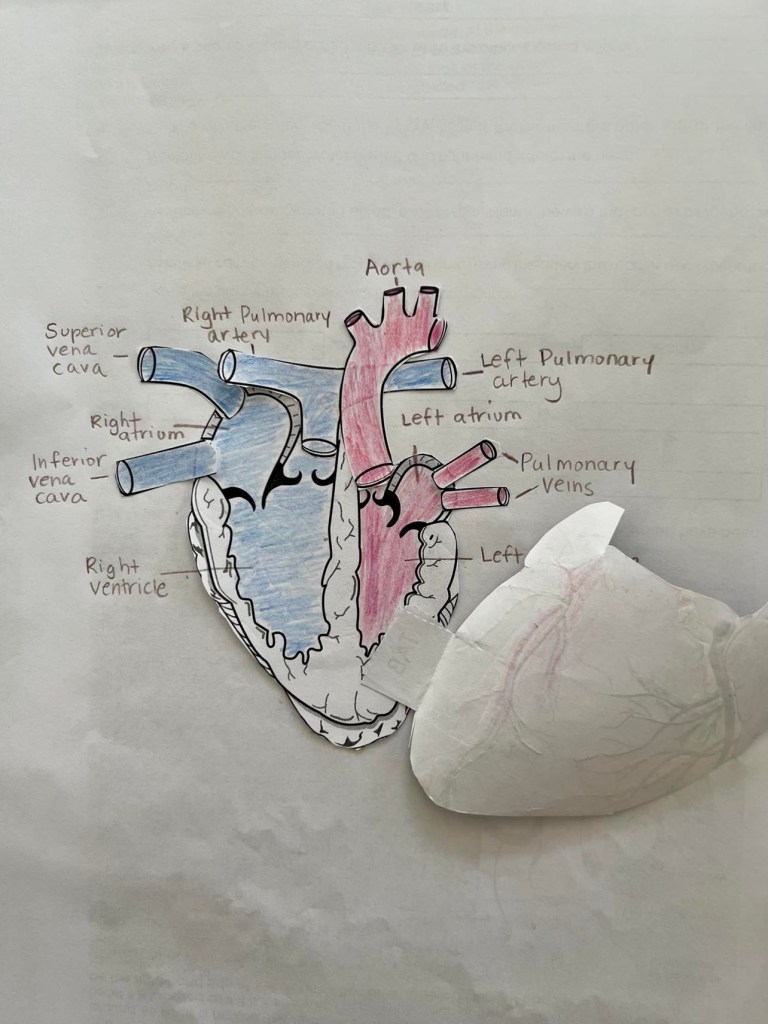
Activities like assembling, colouring and labeling the heart was a huge hit with the students.

Week 5
Being back a after four weeks has meant that the students returned 2 weeks before I was able to. While I was very eager to pick up on where I left off, I saw many the same looks that I did on my first day of class here. It felt a bit like I was starting over again. For a couple of my classes, they were in the final revision of topics or preparing for an assessment, so the mood was also different. There were fewer lessons being delivered and more time given for independent study or finishing tasks that were originally missed. I spent a lot of time this week, simply touching base with everyone- both students and staff. Asking them how things were going, where the challenges are and what I could do to help. Although I was only able to teach a couple of lessons, it felt good to be putting together lessons again. What I am discovering is that finding songs and stories that can hook or bring Mātauranga Māori into the classroom is very hard. I easily spend a couple of hours each night looking and looking… If only there was a library somewhere that would house these resources in once place!.
Week 6
What an interesting week. Assessments began in two of my classes and I saw a very different side to many of the students. Some, who were previously disruptive, became focused and polite. While others completely disengaged and refused to be assessed. For me, it showed that behind the bravado a lot of these students are very vulnerable to feeling the like a failure. Maybe I have this completely wrong, but I now think that the most disruptive students aren’t the most confident, but rather are trying to distract from a feeling of being judged or evaluated. If this is the case, what is the cause and solution? Could this be caused by the continued need for approval on social media? Or a generational overload of information that leads to anxiety? How can I help bring a sense of safety and support to the classroom to alleviate some of these issues? I definitely think getting them to take more ‘controlled’ risks, perhaps via experiments, could be a start to building more trust. And perhaps more time working as a team in the class is needed.


Week 7
I spent a lot of time thinking about what the principal at Waimea said to us, (student teachers) this week. Specifically, that ~50% will leave the profession in the first 4 years, because working as a beginner teacher is very, very hard. This was not something I expected in our pep talk. While I didn’t think it would be an “easy” profession to start out in, I was shocked by those statistics. As I thought about it throughout the week, I realised that I am very lucky to be training in a well-resourced school, with helpful staff and respectful students. And, that I should consider all when applying for jobs. I do not want to be a negative statistic. In the classroom, teaching is becoming a lot more fun with the students. Some are coming out their shells and there is a lot more laughter. I find that if I can add a little humour to every lesson, whether it is through a game or quiz, there is greater engagement with each other and the subject materials. Hooray for humour, it is definitely must in my teaching!


Week 8
It feels strange to think that this is my final week here. I am really going to miss my students. I can’t believe how quickly this placement has gone. At school, there is a buzz in the air. Year 10s are back after a week of staying at home and year 9s are back from camp- so the campus is full of energy as they catch up with their friends. For this reason, lessons had a large component of revision in the form of games, group work and the odd… let’s stand up and shake it off! It was fun and seemed to work to keep them engaged. My more difficult year 12 class also seemed more focused when I changed my approach and gave them the option to work in groups. From what I have experienced, all of these decisions becomes easier when we get to know each other better and understand the expectations. It is for this reason that I am sad to say goodbye. I feel like I am just beginning to know my students and I will miss seeing them, being part of their lives and growing as their kaiako.
Term 2
Reflections – Week 1
Wow, what a week. The first thing I would say I noticed is how loud the student are here. The volume seems to have been turned up a notch (or 10) and there doesn’t appear to be a way to bring it back down. The classrooms never seem to settle, with disruptive behaviour being the ‘norm’. I have had lots of teachers and students ask me why I would ever want to be a teacher. I have to admit, it did make me think a lot about it… as well as why they would think it isn’t a good career. One question about this stick out to me. A year 10 young lady asked me ” Are you sure you want to be a teacher?” I replied, “Yes, I am pretty sure I do.” She looked at me very seriously and asked another question ” Why? Do you not like your hair?” I looked at her puzzled… her follow up was timed perfectly… “because we will make you pull all of it out!” hahahahaha! That is why I love being here. I think it will be a challenge, but it is ākonga like this that make everything worth it.
Week 2
Oh my goodness. One of my ATs was away for the week and I was able to see what it is like for relief teachers here. Unfortunately a shortage of teachers has meant that substitution is more common than not- and the lack of stability, predictability is not working long-term for many, if not most of the ākonga. Although I know the relief teachers tried, it was hard to keep the students on task. sigh… I feel like somehow we are failing them both- the students and the relief teachers. No one left the classroom smiling. With regard to my teaching, I finally got to teach 4 lessons – reviewing genetics (year 11) and evolution (year 13). It was great to put some resources together that would provide immediate feedback via a game (Gimkit). No one had used this game/ formative assessment yet at this school and the ākonga loved it. It also gave me excellent insight into where the knowledge gaps are for future lessons. Finally, we had a teacher only day on Friday and it was nice to just sit and chat with my ATs. This time to chat is luxury here and I really enjoyed getting to know them better as people as well as teachers.
Week 3
This week was a roller coaster ride. I taught 11 lessons across four years and 3 subjects. I have found that lesson planning can be tricky when it is aimed at reviewing a whole unit when the ākonga seem to be at many different stages of learning. I am continuing to seek guidance from the student support office about ways I can tailor my lessons to be more inclusive – but at the end of the day, I have found that it really takes getting to know each individual and what their strengths are. Of course, getting to know each student is not really possible in a very busy classroom of 24 but I am watching more and saying less when possible. Reading the room is the skill I am actively trying to develop. It seems that this skill, along with having multiple activities ready that can de-escalate strife in the classroom are going to be key to my classroom management practices. While I know it is important to have a lesson planned, it is no good if the class time is spent in a stand-off with students who are agitated and/or uncooperative.

Week 4
I am now teaching 2 – 3 classes a day and it is both fun and exhausting. My year 9 class continues to present me challenges that I am not exactly sure how to handle. I have met multiple times with the student resources team for suggestions, but it seems that there is no magic bullet for some of the behaviours. Because of the continued disruptions, my AT and I have decided the best way forward may be to co-teach this class. I am very happy with that, as I would still like to introduce science tools such as microscopes and microbalances – both of which require a level of respect and focus to avoid damaging the equipment. My other classes are comparatively a breeze (thank goodness). I have been making gimkits and kahoot! quizzes for review of senior classes- and this approach has been a hit. I have been gauging the impact of using these gaming tools to solidify vocabulary and concepts and have seen a huge improvement in recall (from ~65% to >90% when used for 5 minutes at the start or end of each lesson). I appreciate my ATs letting me try new things in the lessons and helping me to navigate best practices when faced with challenging classroom behaviour.
Week 5
This week started off a bit rough. I woke up on Monday with a sore throat and earache… so stayed home Monday and Tuesday until it passed. Wednesday was a busy day with lots of exam revision and junior classes plowing on as usual. My external examiner arrived on Thursday morning to assess my lesson and it was very interesting to see how my ākonga responded to having my assessor in the class. Unlike at any other time, they were quiet as church mice. If they would have had masks on, I wouldn’t have recognised them! haha. When I told my AT about how well behaved they were, she laughed and said that it was a sign that they actually liked me. If they didn’t, then they wouldn’t have cared about how their behaviour impacted me. This really made me think. I now know that they DO have the ability to be engaged and polite – but that part of them must be earned and not demanded of them. So many lessons this week, both in the class and in life.
Week 6.
This week the seniors had their derived grade exams, so I opted to accompany one of my challenging Year 9 classes to ALL of their classes. The time I spent with the class and observing the different approaches to teaching was very helpful. While none of them had a magic bullet, I did note that behaviours of the most disruptive ākonga significantly improved when a senior boy attended the class as a teacher aid and when physical games were involved in the lessons. Also, a few of them seem to be more settled when they were allowed to eat throughout the lesson. Unfortunately, the latter isn’t an option in the science room, but incorporating physical activities and games into the lesson, or as a reward, will be on my short list of things to add to my lesson plans.
Week 7.
There was a lot of down time in my senior classes this week due to derived grade exam marking and feedback. However, my junior classes still carried on as usual. Regardless of which year, all of the ākonga seemed tired and restless in anticipation of the 2-week break that starts next week. While there was still a lot to do, it was harder than ever to keep students focused and on-task. By the end of the week everyone was ready to have a bit of fun. My last day was full of games, treats- like making ice cream in the lab- and laughter. I will definitely miss this school and I am grateful for the challenges it gave me. I know I still have a lot to learn but with time, an open heart and mind, I feel this great journey has only started.


 Welcome to my PCT page